
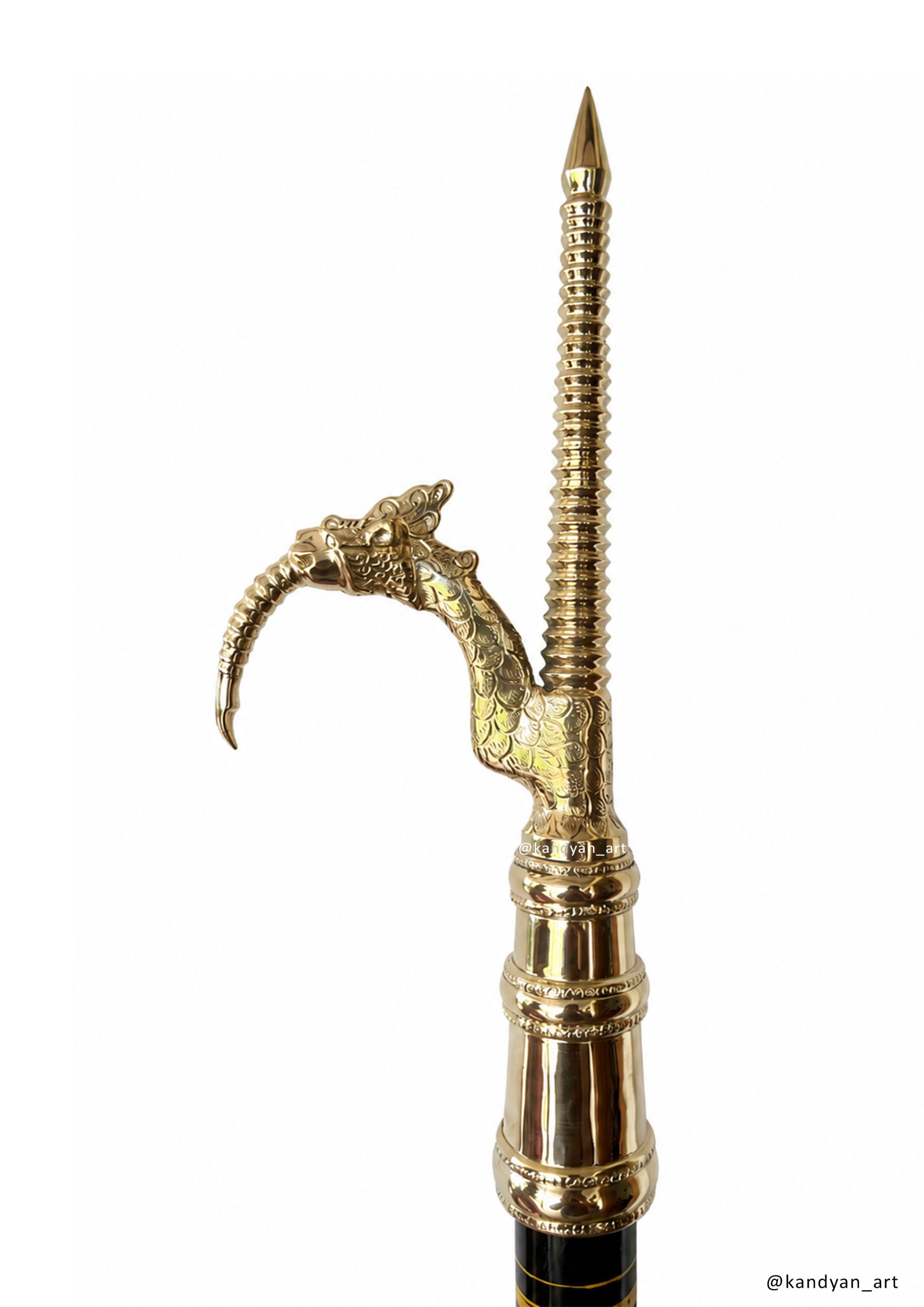
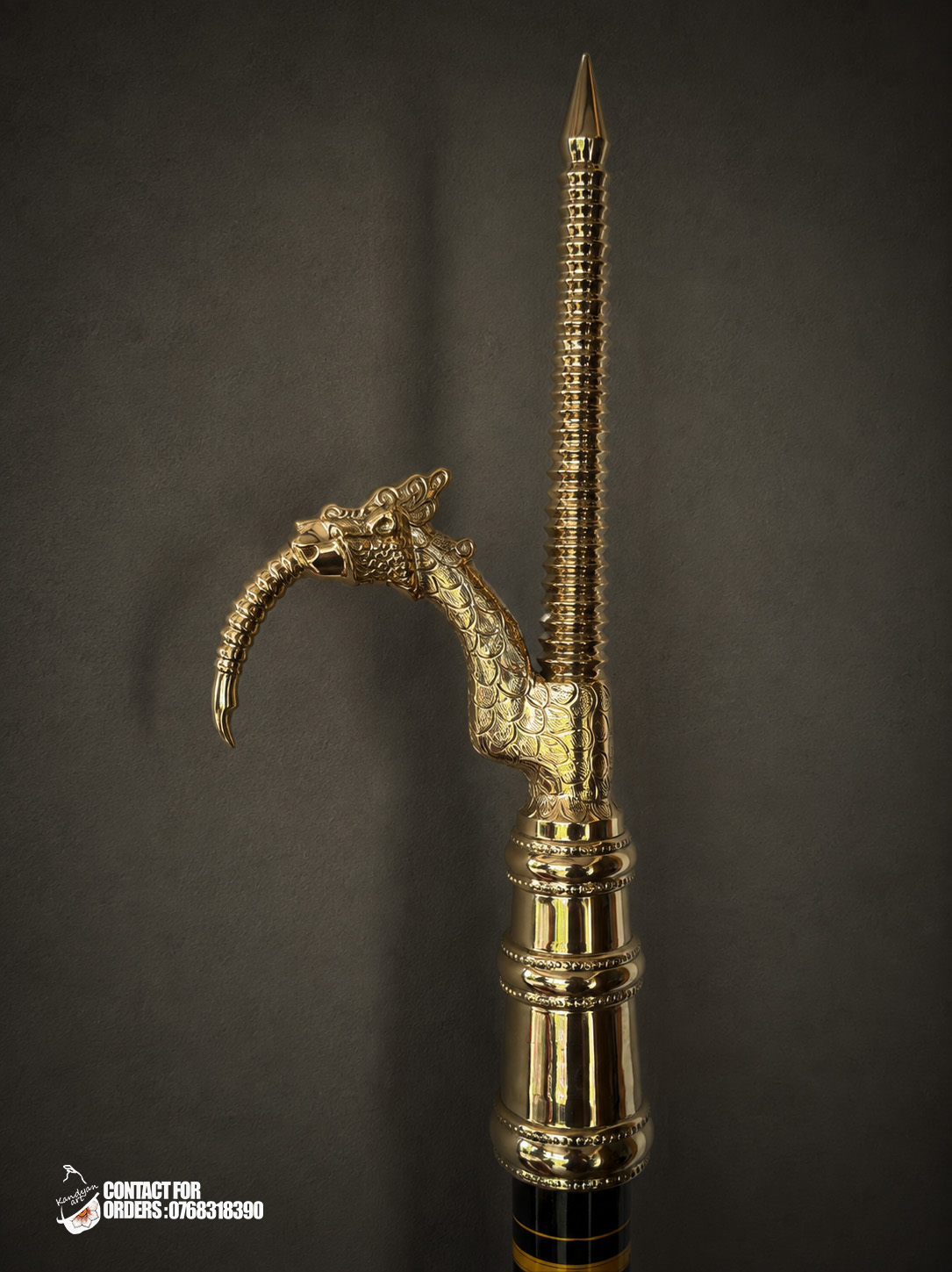

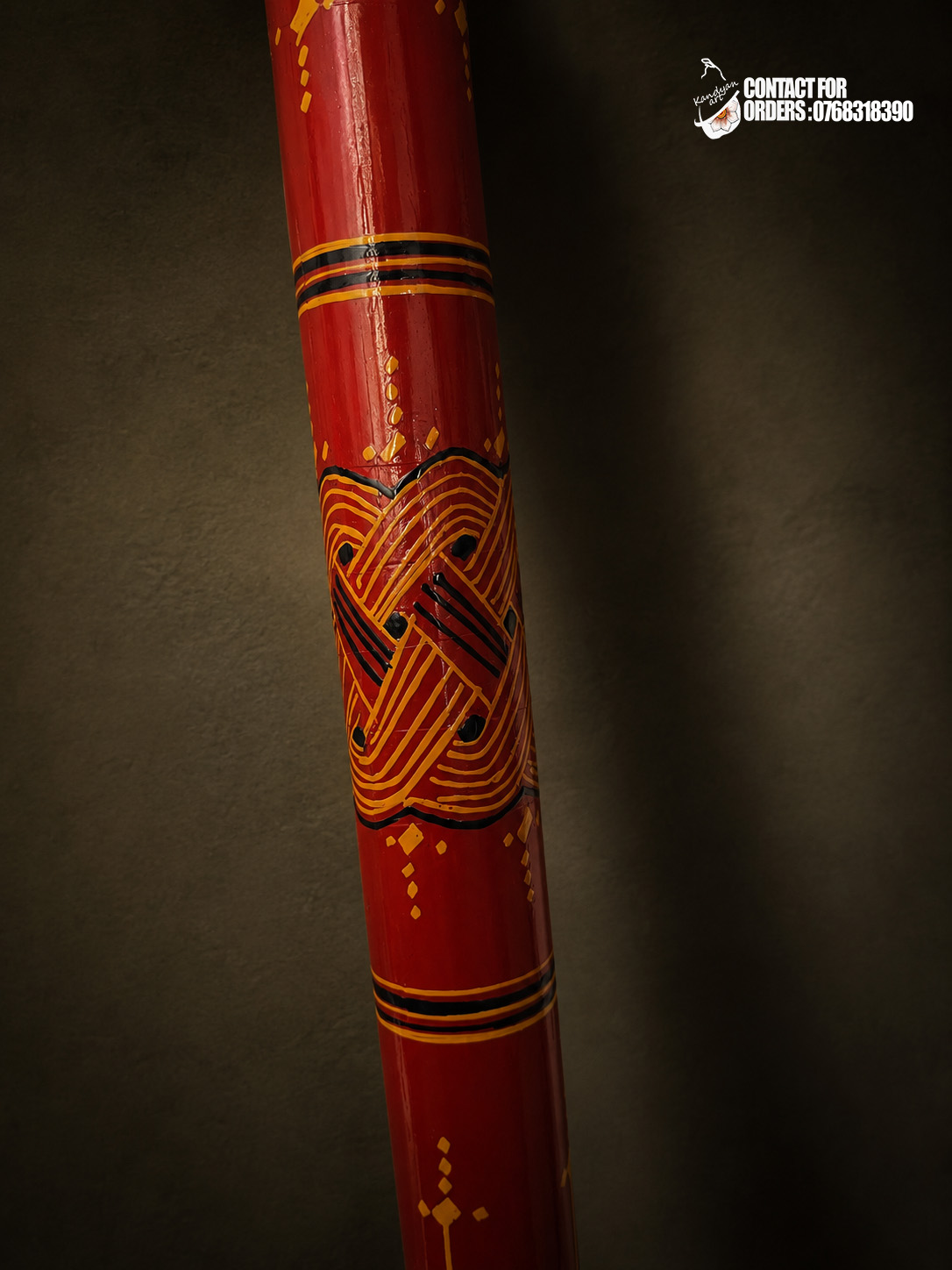
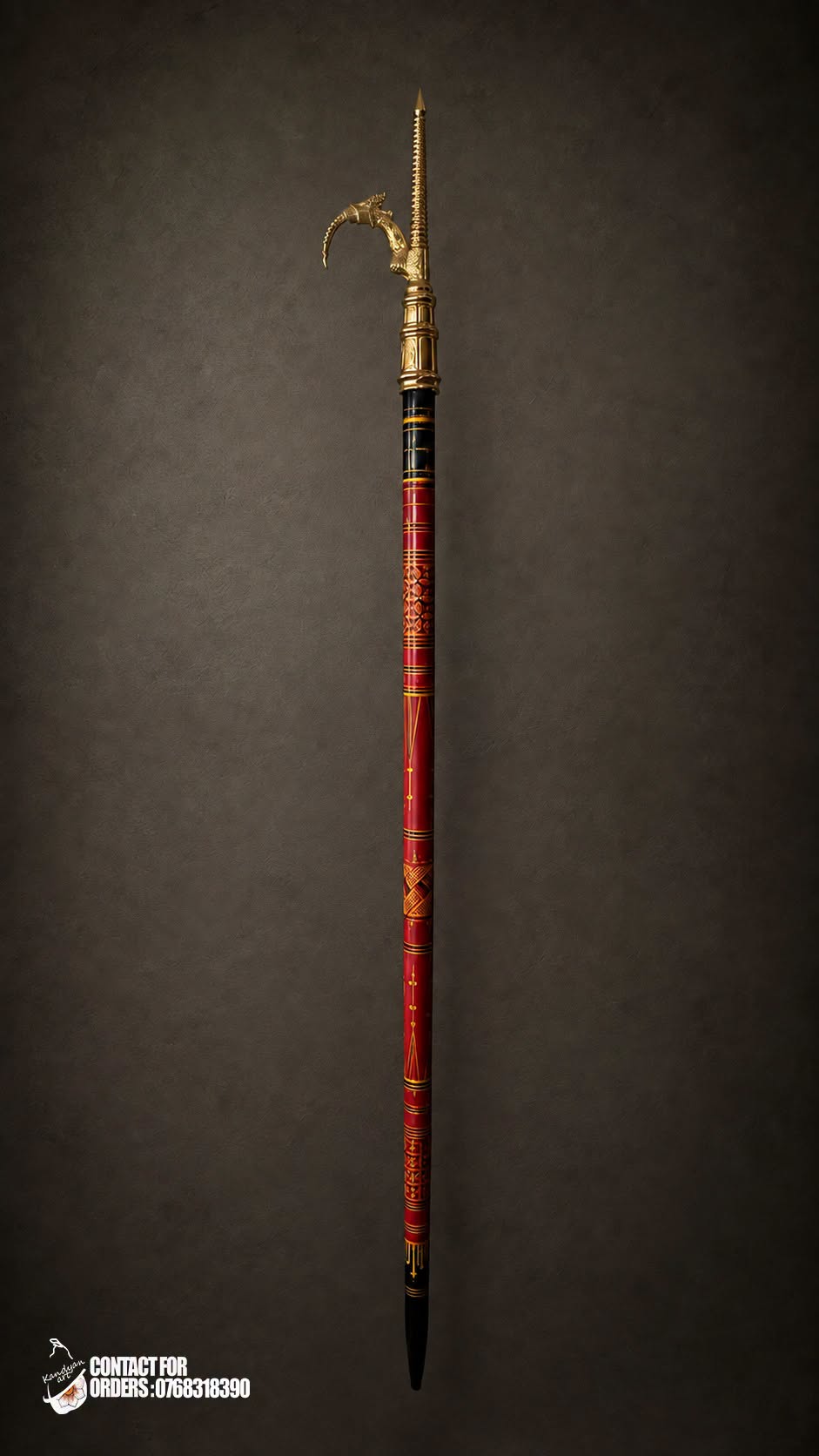


Description
Manufacture Time
Each Ankusha is meticulously handcrafted using traditional Sri Lankan techniques, requiring approximately 6 days to complete, depending on the complexity of the design and customization requested.
The Ankusha (Henduwa) – The Ancient Instrument That Guided Kings, Warriors and Giants
Since the earliest civilizations of South Asia, few relationships have been as remarkable as that between human beings and elephants. Long before the development of modern transportation or machinery, elephants shaped kingdoms, transformed warfare, carried monarchs, built cities, transported enormous stones, participated in sacred ceremonies, and became enduring symbols of royal authority, wisdom and spiritual strength. Guiding an animal that could weigh more than five tonnes required not only courage but also generations of accumulated knowledge. At the heart of that relationship stood one of the oldest surviving tools in human history: the Ankusha, also known as the elephant goad.
The Ankusha is far more than a simple implement. Throughout history it represented authority, responsibility, discipline, communication and trust between the mahout and the elephant. In its simplest form, the tool consists of a handle fitted with a curved hook and a pointed tip. Although physically modest in size, its significance extends across archaeology, military history, religion, metallurgy, art and royal culture. For more than two thousand years, it has remained one of the defining symbols of elephant management across South Asia.
The word “Aṅkuśa” (Sanskrit: अङ्कुश) literally refers to an elephant goad. The name appears in Sanskrit literature and eventually spread throughout South Asia with regional variations in pronunciation and design. While local craftsmen developed distinctive artistic styles, the essential purpose of the instrument remained remarkably consistent: to provide clear directional guidance to one of the world’s largest land animals while allowing the handler to communicate efficiently from a seated position on the elephant’s neck.
Archaeological discoveries demonstrate that the Ankusha possesses extraordinary antiquity. Scholars have identified its appearance in India as early as the 6th–5th centuries BCE, making it one of the oldest continuously used animal handling tools known anywhere in the world. Particularly important are discoveries from the ancient city of Taxila (Takṣaśilā), where well preserved ankushas dating between the 3rd century BCE and the 1st century CE were recovered during archaeological excavations. These finds confirm that the instrument was already highly developed during the early historic period, reflecting a sophisticated tradition of elephant management.
The Ankusha also appears in some of the earliest visual records of elephants in South Asian art. Stone reliefs at Sanchi and murals in the Ajanta Caves depict elephants being directed by skilled drivers carrying ankushas. These works are valuable because they show that the instrument was already considered an essential part of the mahout’s equipment. They also illustrate the highly organized role of elephants in warfare, state ceremonies, and religious processions.
Contrary to popular assumption, historical evidence indicates that the Ankusha was primarily a communication tool, not a weapon. An experienced mahout relied on voice commands, body posture, leg pressure and long familiarity with the elephant. The ankusha served as a precise extension of those signals, helping direct movement when verbal cues alone were insufficient. The relationship between mahout and elephant often developed over many years, with successful handling depending more on mutual understanding than on force.
As elephant management became increasingly important to royal courts, the Ankusha itself evolved from a practical implement into a work of art. Surviving historical examples preserved in museums reveal extraordinary craftsmanship. Handles were fashioned from brass, steel, ivory, hardwood, silver or gold according to the owner’s status. Many ceremonial ankushas feature makara heads, floral scrolls, mythical animals and intricate engraved ornamentation. Some examples appear to have been created specifically for royal ceremonies rather than everyday work, reflecting the prestige attached to elephants and their handlers.
Within Hindu traditions, the Ankusha acquired profound symbolic meaning. It became one of the sacred emblems carried by Ganesha, representing guidance, mastery over obstacles and disciplined control of the mind rather than domination through force. Later Buddhist traditions also adopted the Ankusha as a metaphor for wisdom directing the restless human mind toward enlightenment. Thus, an object originally developed for elephant management gradually became a symbol of spiritual guidance and self mastery across multiple religious traditions.
Sri Lanka occupies a particularly important place in this history. For more than two millennia, elephants have played central roles in the island’s monarchy, religion, engineering, transport and ceremonial life. Royal elephant stables, temple elephants, and the renowned processional traditions of the island all required highly skilled mahouts equipped with reliable tools. Although surviving historical Sri Lankan ankushas differ in decorative style from those of India, they belong to the same long tradition of elephant management that developed across South Asia. Historical studies of Sri Lanka’s elephant culture demonstrate the remarkable continuity of this knowledge from ancient kingdoms into the modern era.
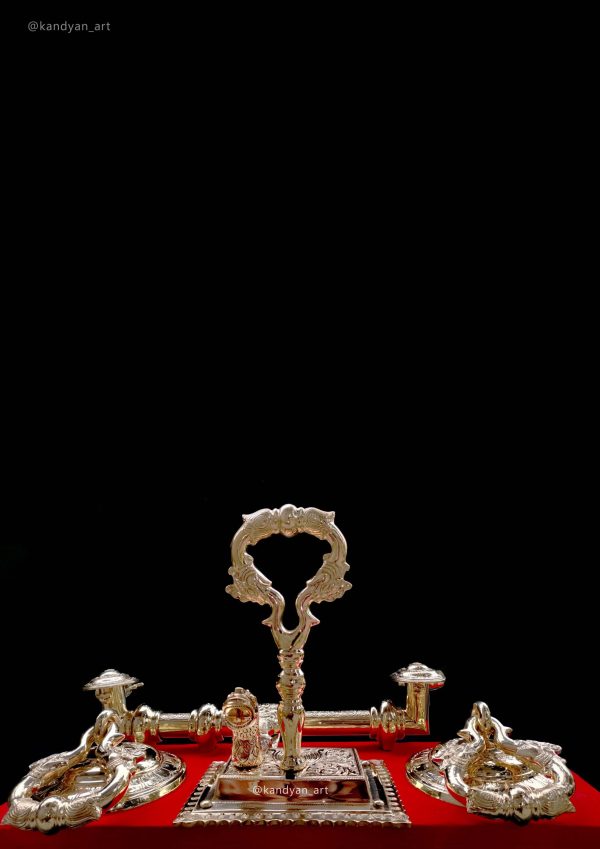
Today, the traditional Brass Ankusha stands as more than a historical object. It represents centuries of craftsmanship, practical engineering, cultural symbolism, and the enduring partnership between humans and elephants. Whether displayed as a heritage artifact, preserved in a museum collection, or handcrafted by modern artisans using traditional techniques, the Ankusha continues to embody one of the world’s oldest living traditions of elephant stewardship.
The Birth of the Ankusha – From Wild Forests to Royal Kingdoms
The emergence of the Ankusha cannot be understood separately from the long history of human interaction with elephants. The instrument was not created as an isolated invention, but as the result of a complex relationship that developed over thousands of years between human societies and one of the most powerful animals of the Asian continent. Before elephants became symbols of kingship, military strength, and religious importance, they existed as wild animals moving through the forests, river valleys, and grasslands of South Asia. The transformation of the elephant from a wild creature into a carefully managed partner of human civilization required the development of knowledge systems that included capture techniques, behavioural understanding, training methods, healthcare and specialized tools.
Unlike animals such as horses, cattle and dogs, which were gradually transformed through selective breeding over many generations, Asian elephants were not domesticated in the same way. Modern scholars generally describe them as tamed rather than domesticated animals because most working elephants throughout history were captured from wild populations and trained for human purposes. This distinction is important because it explains why ancient elephant traditions depended so heavily on individual relationships between handlers and elephants. The success of elephant management was not based on changing the species itself, but on developing deep knowledge of elephant behaviour and creating methods through which humans could communicate with an animal many times larger and stronger than themselves.
 The earliest interactions between humans and elephants likely began through hunting, observation and gradual adaptation to living alongside elephant populations. Archaeological evidence from South Asia shows that elephants were known to prehistoric communities, appearing in ancient art, tools and symbolic representations. Over time, as societies became more organized and agricultural settlements expanded, elephants gained new importance. Their enormous physical strength, intelligence and ability to learn complex tasks made them valuable resources for emerging states.
The development of organized elephant management appears to have accelerated during the rise of early Indian kingdoms. By the first millennium BCE, elephants had become closely connected with political authority and warfare. Their ability to move heavy materials, clear forests, participate in ceremonies, and serve in armies made them strategic assets controlled by rulers. As kingdoms expanded, elephants were no longer simply animals encountered in the wilderness; they became part of state administration.
This transformation created the need for specialized knowledge. Capturing a wild elephant was only the beginning of a much more complicated process. A captured elephant had to be gradually accustomed to human presence, trained to respond to commands, provided with appropriate food and care and observed throughout its life. These responsibilities created a class of specialists whose expertise became essential to royal institutions.
The people who developed this knowledge were the ancestors of the traditional mahout communities. Although the term “mahout” became widely used across South Asia in later periods, the profession itself is much older. Ancient societies required individuals who understood elephant behaviour, movement, health and temperament. Their knowledge was not limited to riding an elephant; it included every aspect of maintaining a relationship with the animal.
Ancient Indian political literature provides evidence that elephant management had become a highly organized state activity. The Arthaśāstra, traditionally associated with Kautilya (also known as Chanakya), contains detailed discussions regarding elephant forests, elephant officers, training, military organization and administrative control. Although scholars continue to debate the exact composition and chronology of the text, it clearly reflects a period when elephants were considered valuable state resources requiring formal management.
The concept of elephant forests described in ancient administrative traditions reveals an important aspect of early conservation practices. Rulers understood that elephants could not be obtained endlessly from uncontrolled hunting. Wild elephant populations needed protection because they represented a continuing source of military and economic power. Certain forest regions were therefore managed specifically for elephant capture and preservation. These areas were not conservation reserves in the modern scientific sense, but they demonstrate an early recognition that elephant populations required organized protection.
As kingdoms developed stronger political structures, elephants became associated with royal authority. Possessing trained elephants demonstrated wealth, organization and military capability. A ruler who maintained elephant forces required not only animals but also entire systems of support, including forests, trainers, physicians, stable workers and experienced handlers. The elephant became a reflection of the strength of the kingdom itself.
This historical environment created the conditions in which the Ankusha developed and became established as an essential tool. A large animal such as an elephant could not be effectively guided through physical strength alone. The handler needed a method of providing precise signals while seated on the animal’s neck or head. The Ankusha functioned within this communication system, allowing the mahout to reinforce learned commands and direct movement when necessary.
The earliest development of such tools was probably practical rather than artistic. The first elephant goads were likely simple implements created from available materials such as wood, bone or metal. As metallurgical knowledge advanced, stronger and more durable versions appeared. Over time, blacksmiths refined the shape, balance and construction of the tool according to the needs of elephant handlers.
 The evolution of the Ankusha reflects the same principle seen throughout ancient technology: tools developed through continuous interaction between human experience and practical necessity. The curved hook, the pointed extension, and the balanced handle were not random decorative choices. They represented generations of observation regarding how a handler could communicate effectively with an elephant while maintaining control and safety.
The rise of elephant warfare further increased the importance of skilled elephant handlers and their equipment. Across ancient South Asia, war elephants became symbols of military power. They carried soldiers, protected important positions, disrupted enemy formations and represented the authority of kings. However, the effectiveness of a war elephant depended not only on the animal itself but also on the expertise of the person guiding it.
Historical military traditions recognized that an uncontrolled elephant could become dangerous even to its own side. Therefore, experienced mahouts were among the most important members of an elephant corps. Their knowledge determined whether an elephant became a reliable military asset or a potential threat. The Ankusha, in this context, was not a symbol of domination but part of a wider system of communication between the handler and the animal.
The importance of elephants also spread beyond warfare. In royal ceremonies, religious processions, construction projects, and diplomatic activities, elephants represented power and prestige. Kings used elephants during public events to display authority and prosperity. Temples and religious institutions also incorporated elephants into ceremonial traditions because of their symbolic associations with strength, dignity and wisdom.
In Sri Lanka, this broader South Asian elephant tradition developed its own distinctive character. The island’s forests supported significant elephant populations, and ancient kingdoms incorporated elephants into political, military and religious life. The arrival and spread of Buddhism during the third century BCE further strengthened the cultural importance of elephants, as the animal became connected with Buddhist symbolism and royal traditions.
The chronicles of Sri Lanka, including the Mahāvaṃsa and Dīpavaṃsa, contain numerous references to elephants in relation to kings, battles, ceremonies and important historical events. These texts must be interpreted carefully because they combine historical memory with religious and literary elements, but they demonstrate that elephants occupied an important place in the imagination and organization of ancient Sri Lankan society.
By the time Sri Lankan kingdoms developed advanced political and religious institutions, elephant management had already become a highly specialized tradition across South Asia. The Ankusha belonged to this wider cultural system. It was the physical expression of accumulated knowledge developed through generations of interaction between humans and elephants.
Therefore, the birth of the Ankusha was not simply the creation of a metal tool. It was the result of a much larger historical process: the transformation of human elephant relationships from coexistence in the wilderness into organized systems of royal administration, military strategy, craftsmanship and cultural expression. The instrument represents the moment when human knowledge, animal behaviour, and technological skill came together to create one of the most enduring tools associated with Asian elephant civilization.
The Anatomy of the Ankusha – Engineering, Materials, Craftsmanship and Symbolism
The Ankusha is an example of how a practical object can gradually become a work of cultural art. At first glance, it appears to be a simple tool consisting of a handle, a metal shaft, a curved hook and a pointed projection. However, every part of its construction reflects generations of practical experience developed by elephant handlers and metalworkers. The traditional Ankusha was not designed only as an object of utility; its form represents a combination of mechanical understanding, ergonomic awareness, artistic expression, and cultural symbolism.
Because elephants are among the largest land animals on Earth, the equipment used to guide them required careful consideration. A tool that was too heavy would create fatigue for the handler, while one that was poorly balanced would reduce precision. A tool that was too fragile could fail during use. Through centuries of repeated use, craftsmen developed forms that combined strength, balance and efficiency. Although regional variations existed throughout South Asia, the essential structure of the Ankusha remained remarkably consistent because the practical requirements of elephant handling remained similar.
The earliest forms of elephant goads were likely simple implements produced from locally available materials. Organic materials such as wood or bone may have been used before advanced metalworking techniques became widespread. However, as iron and bronze technologies developed in South Asia, metal became the preferred material because of its strength, durability and ability to be shaped into precise forms. Archaeological discoveries and historical collections demonstrate that metal ankushas were already established by the early historic period.
The construction of a traditional Ankusha can be understood through several interconnected parts: the hook, the point, the shaft, the handle, and the decorative elements that transformed many examples from ordinary working tools into artistic objects.
The most recognizable feature of the Ankusha is its curved hook. This curved section gave the instrument its distinctive identity and allowed the mahout to provide controlled signals while positioned above the elephant. The shape of the hook was developed through practical experience, as handlers required an instrument that could communicate precise direction without requiring large movements.
Historical interpretation of the hook requires careful consideration. Modern descriptions sometimes portray the curved hook mainly as a device for applying force, but traditional elephant management depended on a much wider communication system involving voice commands, body movement, trained responses and long term familiarity between the mahout and elephant. The Ankusha functioned within this system as an extension of the handler’s communication rather than as the sole method of control.
The opposite end of many ankushas contains a pointed projection. This feature has contributed to many misunderstandings about the instrument. While the pointed section could provide a sharp tactile signal when required, historical evidence suggests that everyday elephant handling relied primarily on training and communication rather than continuous physical pressure. Experienced mahouts developed relationships with elephants over many years, and the tool was only one part of a much larger tradition of knowledge.
The central shaft of the Ankusha provided the connection between the working end of the tool and the hand of the user. The length and thickness varied according to regional traditions, intended purpose and individual craftsmanship. Working examples were generally designed for practical use, while ceremonial examples could be larger and more elaborately decorated.
Traditional craftsmen understood the importance of structural strength even without modern engineering terminology. The transition between the hook and the shaft was often shaped with smooth curves rather than sudden angles because abrupt changes in form could create weak points. This reflects an understanding developed through observation and repeated craftsmanship.
The handle represented one of the greatest areas for artistic creativity. Practical ankushas required a secure grip, especially when used during movement or ceremonial situations involving large animals. Craftsmen therefore developed handles with carefully selected materials and surface treatments to improve comfort and control.
Materials used in Ankusha production varied according to region, historical period and the status of the owner. Iron and steel were common because of their strength and availability. Bronze and brass became particularly important because they combined durability with decorative possibilities. Wealthier patrons commissioned ankushas incorporating precious materials such as silver, gold, ivory and finely carved hardwood.
Brass holds a particularly significant place in the later artistic tradition of ankusha production. The material was valued because it could be cast into detailed forms, engraved with intricate patterns, polished to a bright golden appearance and preserved for generations. Unlike iron, which requires protection from corrosion, brass develops a distinctive aged surface that many collectors and historians value as part of its character.
The selection of brass was therefore not only practical but also cultural. The warm golden colour of polished brass naturally associated the object with dignity, ceremony and permanence. This made it especially suitable for objects connected with royal traditions, temples and heritage craftsmanship.
- The Symbolic Language – Ath kanda Lihiniya (ඇත්කඳ ලිහිණියා), Makara and Sarapenda
 The decorative elements of the traditional Sri Lankan Ankusha reveal a deeper artistic language that extends beyond the practical purpose of elephant management. Although the Ankusha was originally developed as a functional instrument used by mahouts for guiding elephants, Sri Lankan craftsmen often transformed practical objects into cultural expressions by incorporating symbols drawn from mythology, nature and traditional beliefs. This artistic approach can also be observed throughout Sri Lankan temple architecture, royal objects, jewellery, weapons and ceremonial metalwork, where practical design and symbolic meaning exist together.
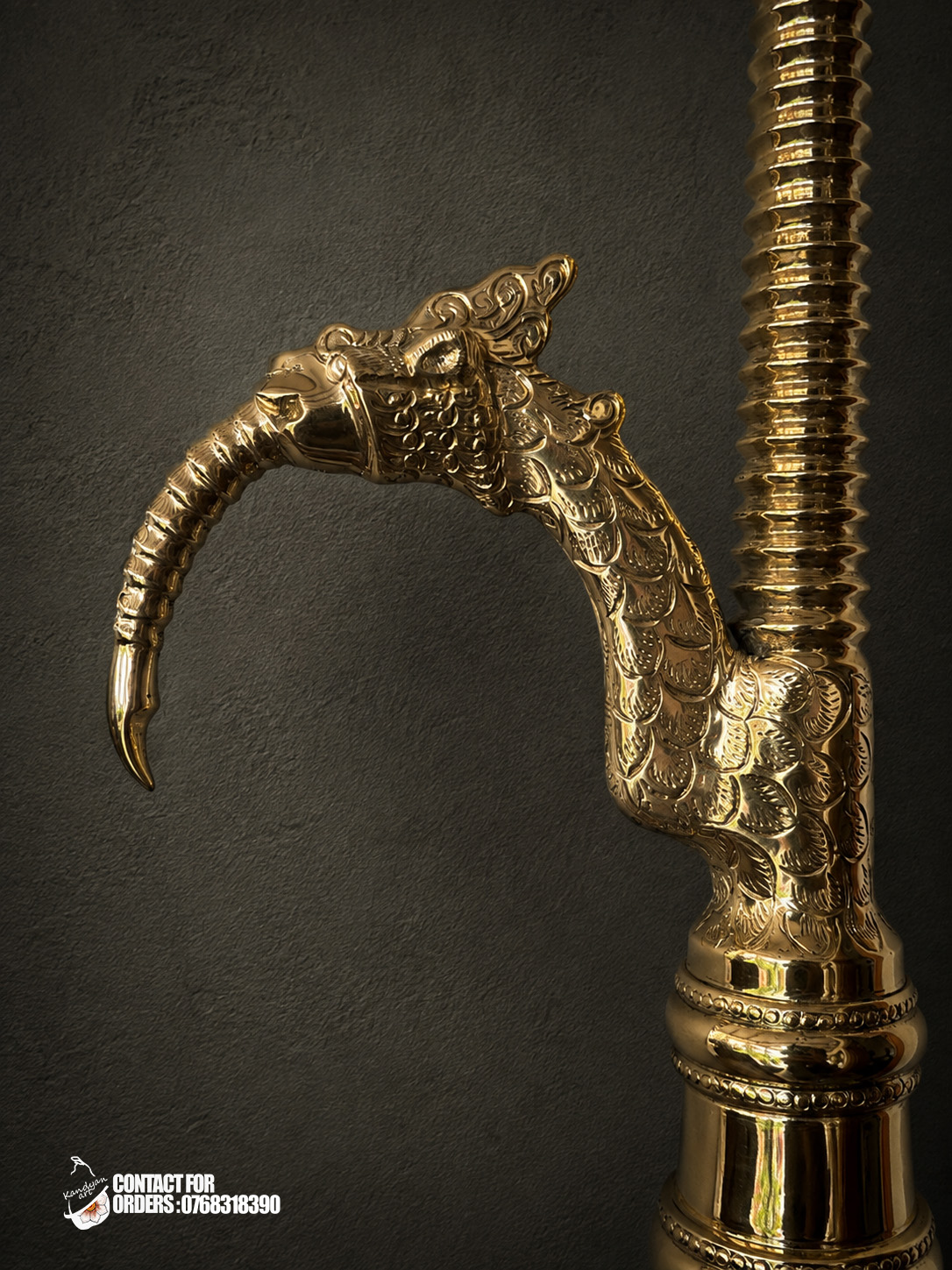
Among the most distinctive symbolic interpretations associated with the Sri Lankan Ankusha is the design of the curved hook. According to traditional knowledge preserved among Sri Lankan brass craftsmen, this curved element is interpreted as representing the powerful claw or talon of the Ath kanda Lihiniya (ඇත්කඳ ලිහිණියා), a legendary bird like creature found within Sinhala folklore traditions.
The Ath kanda Lihiniya occupies a unique position in Sri Lankan traditional imagination because of its extraordinary association with strength. Unlike ordinary birds, this mythical creature was believed to possess immense power, including the ability to seize and carry an elephant with its claws. The name itself reflects this symbolic association: “Ath-kanda” refers to the elephant, while “Lihiniya” refers to a bird, creating the image of a creature whose strength could surpass even the largest and most powerful animal known within the Sri Lankan environment.
A written record of this belief can be found in Henry Parker’s Village Folk-Tales of Ceylon (1910), one of the earliest English collections of Sinhala oral traditions. In Story No. 51, “The Aet kanda Leniya,” Parker records a traditional account describing the mythical bird returning while carrying a tusked elephant. The relevant passage states:
“The Aet Kanda Leni (the female Rukh, their mother), having pierced with its claws a tusk elephant, came bringing it, after flying round the sea in three circles.”
— Henry Parker, Village Folk-Tales of Ceylon, Volume I, Story No. 51, “The Aet kanda Leniya,” London: Luzac & Co., 1910.
This recorded folklore provides important evidence of the cultural belief surrounding the extraordinary strength of the Ath kanda Lihiniya. Although Parker’s work does not discuss the Ankusha itself, it preserves the traditional story world in which this powerful creature existed and demonstrates that such ideas were part of Sinhala cultural imagination.
The symbolism of the Ath kanda Lihiniya becomes especially meaningful when connected with the Ankusha. The Ankusha is an instrument associated with guiding elephants, animals that have long represented strength, royal authority and dignity in Sri Lankan culture. By shaping the curved hook in the form of a mythical creature’s claw, craftsmen created a symbolic relationship between the tool and the legendary power associated with the bird.
In this interpretation, the hook does not represent violence or domination. Instead, it represents mastery through knowledge, strength guided by wisdom, and the ability to communicate with one of the world’s most powerful animals. The symbolism reflects a fundamental principle found throughout traditional Sri Lankan craftsmanship: true authority is achieved not through force alone, but through understanding, discipline and experience.
Beyond the symbolism of the Ath kanda Lihiniya, traditional Sri Lankan craftsmen also incorporated other mythical forms into ceremonial ankushas, reflecting a wider artistic tradition in which practical objects were connected with stories, beliefs and symbolic meanings. These decorative elements demonstrate that the Ankusha was not viewed only as a functional instrument for elephant management; it also existed within a cultural environment where craftsmanship, mythology, and visual expression were deeply interconnected.
Among the most important mythical motifs associated with South Asian decorative traditions is the Makara. The Makara is one of the oldest and most widespread composite creatures found in the artistic traditions of South Asia, appearing throughout Hindu, Buddhist, and regional cultural expressions. Rather than representing a single identifiable animal, the Makara combines characteristics from different powerful creatures. Depending on the period, region and artistic tradition, it may include features associated with animals such as the crocodile, fish, elephant, lion, boar and other beings, creating a symbolic creature that represents the combined strength of the natural world.
The meaning of the Makara developed through centuries of religious, artistic and cultural traditions. It is commonly associated with water, fertility, prosperity, protection, abundance and the mysterious forces of nature. Because of these associations, Makara imagery became an important element in sacred architecture, temple gateways, sculpture, jewellery, royal objects, and ceremonial instruments throughout South Asia. The presence of the Makara often indicated ideas of protection, auspiciousness, and the connection between human society and powerful natural forces.
When incorporated into a traditional Ankusha, the Makara motif transformed the instrument from a purely practical object into a representation of a broader cultural world. A Makara decorated Ankusha connected the knowledge of elephant management with ideas of protection, strength and symbolic authority. The decorative form did not change the practical purpose of the instrument; rather, it added another layer of meaning that reflected the beliefs and artistic values of the society that created it.
Another significant mythical form found within Sri Lankan artistic traditions is the Sarapenda (සරපේන්දා), also written in some sources as Sarabha or Sarabendiya depending on regional and artistic contexts.. Similar to the Makara, Sarapenda represents the traditional artistic practice of combining characteristics from different creatures to create a powerful symbolic being. It appears in Sri Lankan decorative arts, architectural ornamentation, traditional illustrations, and other forms of craftsmanship where extraordinary creatures were used to express ideas of strength, protection, and exceptional power beyond ordinary animals.
The inclusion of such mythical forms on ceremonial ankushas reveals the relationship between the artisan’s skill and the cultural imagination of traditional Sri Lanka. The craftsman was not simply producing a metal tool; every curve, figure, and decorative element could carry a deeper meaning connected with folklore, royal traditions, religious beliefs, and the ancient relationship between humans and elephants. The Ankusha therefore became a meeting point between practical knowledge and symbolic expression, where the experience of the mahout and the creativity of the artisan existed together.
The Ath kanda Lihiniya, Makara and Sarapenda represent different aspects of the symbolic language surrounding the traditional Sri Lankan Ankusha. The Ath kanda Lihiniya reflects extraordinary strength through folklore, the Makara represents the power and mystery of nature and the Sarapenda reflects the artistic transformation of multiple forms into a symbol of exceptional qualities. Together, these motifs demonstrate how traditional craftsmen used mythology and imagination to preserve cultural ideas within functional objects.
Therefore, the traditional Sri Lankan Ankusha is not merely a metal instrument. Its design preserves multiple layers of knowledge: the practical experience of mahouts, the technical mastery of craftsmen, and the cultural imagination of generations who connected the strength of elephants with powerful symbolic creatures. Through these artistic interpretations, even a small component such as the curved hook becomes a lasting record of Sri Lanka’s relationship between craftsmanship, folklore, mythology, and the ancient tradition of elephant culture.
The Mahout Tradition – The Knowledge Behind the Instrument
 The Ankusha, despite its historical importance and artistic beauty, has always been secondary to the knowledge of the person who used it. The instrument itself could never guide an elephant without the experience, discipline and understanding of the mahout. For thousands of years across South Asia, elephant management was built upon a relationship between human knowledge and animal intelligence. The mahout represented the accumulated wisdom of generations who learned how to communicate with, care for, and work alongside one of the largest and most intelligent land animals on Earth.
The history of the Ankusha is therefore inseparable from the history of the mahout. Without understanding the role of the elephant handler, the instrument can easily be misunderstood as merely a controlling device. Historically, however, successful elephant management depended on far more than physical tools. It required patience, observation, memory, emotional understanding, and knowledge passed from one generation to another.
The word “mahout” is commonly used today to describe an elephant handler, but the profession itself existed long before the modern term became widespread. Across South Asia, different languages developed their own terms for elephant keepers and drivers. In ancient Indian sources, elephant specialists were associated with various roles involving capture, training, care and military use. In Sri Lanka, traditional elephant handlers were connected with royal institutions, temple traditions, and hereditary communities whose knowledge developed through practical experience.
A mahout was not simply a person who sat on an elephant and gave commands. Traditionally, the mahout was responsible for almost every aspect of the elephant’s life. The relationship often began when an elephant entered human care and continued for many years, sometimes throughout the entire working life of both the animal and the handler. The mahout became the individual who understood the elephant’s habits, temperament, physical condition and behavioural changes better than anyone else.
This close relationship developed because elephants are highly social and intelligent animals. Modern scientific studies have confirmed many abilities that experienced mahouts recognized through generations of observation. Elephants possess complex social behaviour, strong memory, advanced communication abilities, and the capacity to recognize individuals over long periods. Traditional elephant handlers built their methods around these characteristics rather than attempting to overcome them through force.
The training of a mahout traditionally required many years of apprenticeship. Knowledge was usually transmitted through direct observation and practical involvement rather than through formal classroom education. A young apprentice would first learn by watching experienced handlers, assisting with daily care, and gradually developing the ability to understand elephant behaviour.
This education involved learning many interconnected skills. A skilled mahout needed to recognize signs of health and illness, understand feeding requirements, identify behavioural changes, control movement, perform basic care, and respond appropriately in difficult situations. Much of this knowledge was specific to individual elephants because every animal developed its own personality and habits.
One of the most important abilities of a traditional mahout was observation. An experienced handler could identify small changes that indicated an elephant’s physical or emotional condition. Changes in walking style, eating habits, sounds, posture, or general behaviour could provide early warnings of illness, stress, discomfort or fear.
This knowledge was especially important because elephants are extremely large animals. A minor health problem could become serious if unnoticed. Traditional elephant keepers therefore developed practical understanding of anatomy, movement, nutrition and environmental conditions. Their knowledge was not always recorded in written documents, but it was preserved through generations of experience.
Ancient South Asian traditions also developed specialized knowledge concerning elephant medicine. The text known as Hastyāyurveda, traditionally associated with the elephant physician Pālakāpya, represents one of the most important surviving examples of this tradition. Although scholars continue to examine its historical development and date, the work demonstrates that ancient societies treated elephant care as a specialized field requiring systematic knowledge.
Such traditions recognized that maintaining an elephant required more than training. Health, diet, environment, and behaviour were interconnected. An elephant that was physically unhealthy or emotionally disturbed could not perform effectively in royal, military or ceremonial roles.
The daily relationship between mahout and elephant was built through routine. Feeding, bathing, grooming, movement and training created familiarity and trust. These activities were not separate from elephant management; they formed the foundation upon which communication was developed.
Bathing was particularly important in traditional elephant care. Elephants naturally depend on water for cooling and skin maintenance, and bathing also provided an opportunity for the mahout to inspect the animal’s condition. During these interactions, the handler could observe injuries, skin problems, changes in behaviour, or other signs that might require attention.
Communication between elephant and mahout developed through a combination of methods. Voice commands formed the foundation of training. Elephants learned specific words, sounds and signals through repetition over long periods. Physical positioning, body movement, and touch were also used to communicate intention.
The Ankusha functioned within this broader communication system. It was not the source of the relationship between human and elephant; rather, it was one of the tools available to an experienced handler. A knowledgeable mahout understood when a command, gesture, or voice signal was sufficient and when additional guidance was necessary.
This distinction is important because historical misunderstandings often reduce the Ankusha to a symbol of domination. In reality, the traditional relationship between mahout and elephant was based on a combination of authority, familiarity, responsibility and dependence. The elephant relied on the mahout for food, care and protection, while the mahout relied on the elephant for work, status and livelihood.
The role of the mahout became especially significant when elephants were used in warfare. Ancient armies considered elephants valuable military assets, but the success of an elephant corps depended heavily on the skill of its handlers. A trained elephant required a person who could maintain control under stressful conditions such as noise, movement and battle environments.
Historical military traditions therefore placed great importance on experienced elephant handlers. A mahout had to understand not only normal behaviour but also how an elephant might react under fear, injury or confusion. The ability to calm and guide an elephant during dangerous situations required years of experience.
Beyond warfare, mahouts played essential roles in royal ceremonies and religious traditions. In many South Asian societies, elephants became symbols of kingship and sacred authority. The handler responsible for a royal or ceremonial elephant carried the responsibility of presenting the animal with dignity during important public events.
Sri Lanka developed a particularly strong connection between elephants and religious tradition. The participation of elephants in Buddhist ceremonies and processions required highly disciplined animals and experienced handlers. The mahout’s role extended beyond practical control; he became part of a cultural tradition in which the elephant represented continuity, respect and heritage.
The knowledge of mahouts was often preserved through family traditions. Because much of this expertise was transmitted orally, historians face challenges when attempting to reconstruct the complete system of traditional elephant management. Written sources provide important information, but they do not always capture the detailed practical knowledge developed through daily interaction with individual elephants.
A master mahout could understand details that were difficult to express in written form: the personality of a particular elephant, its preferred routines, its reactions to unfamiliar situations and the subtle signs that indicated its condition. This type of knowledge represents a form of practical science developed through long term observation.
Traditional elephant handling also included knowledge of sensitive areas of the elephant’s body. Experienced handlers understood that different parts of the animal responded differently to touch and pressure. In Sri Lankan oral traditions, certain concepts such as “Neela” (නීල) are associated with knowledge of elephant sensitivity and response.
However, such traditions must be interpreted carefully. Unlike documented medical systems, there is limited modern scientific evidence confirming a formal system of elephant pressure points comparable to human acupuncture traditions. Therefore, these concepts are best understood as part of traditional mahout knowledge developed through experience and observation rather than as fully documented scientific systems.
The existence of such knowledge demonstrates the depth of understanding developed by elephant handlers. Their expertise was not limited to commanding movement; it involved recognizing the physical and psychological condition of another living being.
The legacy of the mahout tradition is therefore central to understanding the meaning of the Ankusha. The tool represents only the visible part of a much larger system of knowledge. Behind every historical Ankusha existed generations of handlers who understood elephants through patience, experience and respect.
For this reason, the true historical significance of the Ankusha does not come from the metal itself. Its importance comes from the human knowledge it represents. The instrument is a reminder that one of the greatest achievements in human history was not simply using the strength of elephants, but developing a relationship in which two very different species could cooperate through communication and understanding.
The Ankusha in Sri Lankan Civilization – Royalty, Religion, Warfare and Heritage
The history of the Ankusha in Sri Lanka cannot be separated from the history of the elephant itself. For more than two thousand years, elephants have occupied a distinctive position within the island’s political, military, religious and cultural traditions. The Ankusha became part of this wider heritage because it represented the knowledge system that allowed humans to work with elephants, whether in royal service, warfare, construction, transportation or ceremonial life.
Sri Lanka’s relationship with elephants developed within the broader South Asian tradition, yet the island created its own distinctive identity around these animals. The forests of Sri Lanka supported significant populations of Asian elephants, and ancient communities developed extensive knowledge of their behaviour and management. Over time, elephants became closely connected with the power of kings, the organization of the state, and the expression of religious devotion.
The importance of elephants in ancient Sri Lanka was not based only on their physical strength. Their value came from the combination of intelligence, endurance and symbolic meaning. An elephant represented qualities highly valued by ancient societies: strength, stability, dignity and authority. Because of these associations, elephants became closely linked with kingship and the image of a powerful ruler.
The earliest historical period of Sri Lanka provides evidence that elephants were already integrated into political and military life. The island’s ancient chronicles, particularly the Dīpavaṃsa and Mahāvaṃsa, contain numerous references to elephants in connection with kings, battles, ceremonies and important events. These texts were composed within a Buddhist historical tradition and combine historical memory with religious interpretation; therefore, historians examine them together with archaeological and comparative evidence rather than treating every narrative detail as a direct historical record.
Nevertheless, the repeated presence of elephants within these chronicles reflects their undeniable cultural importance. Elephants were not presented as ordinary animals but as valuable possessions connected with royal power and significant events.
During the Anuradhapura period, which began around the late fourth century BCE and continued for more than a thousand years, Sri Lanka developed one of the most advanced political systems in ancient South Asia. The kingdom established large scale irrigation networks, monumental architecture, organized armies and complex administrative structures. Within this system, elephants became part of the resources managed by the state.
The maintenance of elephants required specialized knowledge and organization. A royal elephant establishment was not simply a place where animals were kept. It depended on people responsible for capturing, training, feeding, treating and managing elephants. The mahouts who worked within these systems carried knowledge that was essential to maintaining the value of these animals.
The connection between elephants and warfare was particularly significant. Across ancient South Asia, including Sri Lanka, elephants served as important military assets. Their size and strength allowed them to carry soldiers, break enemy formations, transport equipment and create psychological impact on opposing armies.
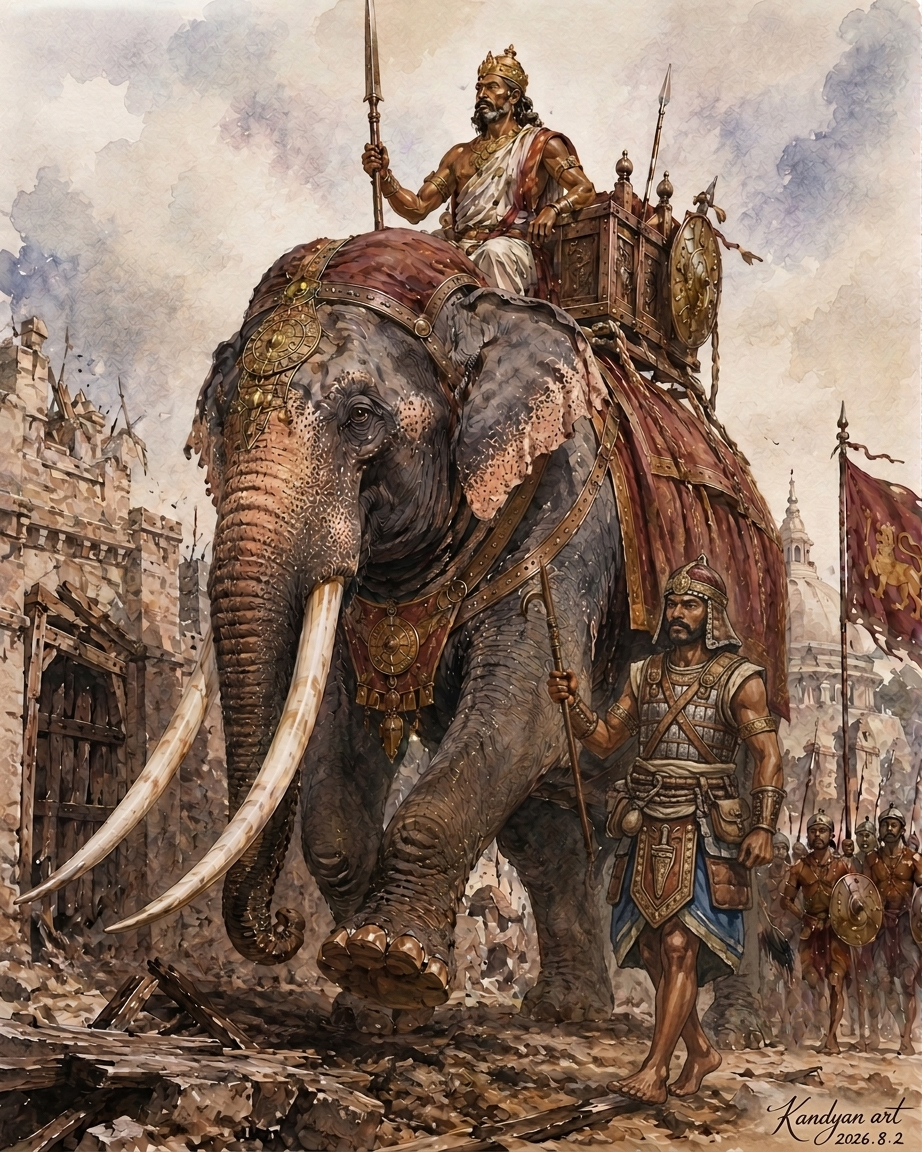 Sri Lankan historical traditions contain several accounts of elephants associated with kings and battles. One of the most famous examples is the elephant Kandula, traditionally associated with King Dutugemunu in the Mahāvaṃsa. According to the chronicle, Kandula played an important role during the king’s campaign against King Elara. While historians interpret such accounts within their literary and historical context, the story demonstrates the importance attached to exceptional elephants within Sri Lankan royal memory.
The military value of elephants also increased the importance of the mahout. A war elephant was effective only when guided by an experienced handler who understood the animal’s behaviour under difficult conditions. The Ankusha, as part of the traditional equipment of elephant handlers, belonged to this larger military and administrative system.
However, the significance of elephants in Sri Lanka extended far beyond warfare. With the establishment and growth of Buddhism on the island after the third century BCE, elephants gained additional symbolic importance. In Buddhist traditions, the elephant is associated with qualities such as strength, wisdom, patience and mental discipline.
The connection between Buddhism and elephants existed from the earliest Buddhist traditions. The well known account of Queen Māyā’s dream of a white elephant before the birth of the Buddha became one of the most recognized symbolic associations between elephants and Buddhist culture. As Buddhism became deeply connected with Sri Lankan kingship and society, elephants naturally became part of religious and ceremonial traditions.
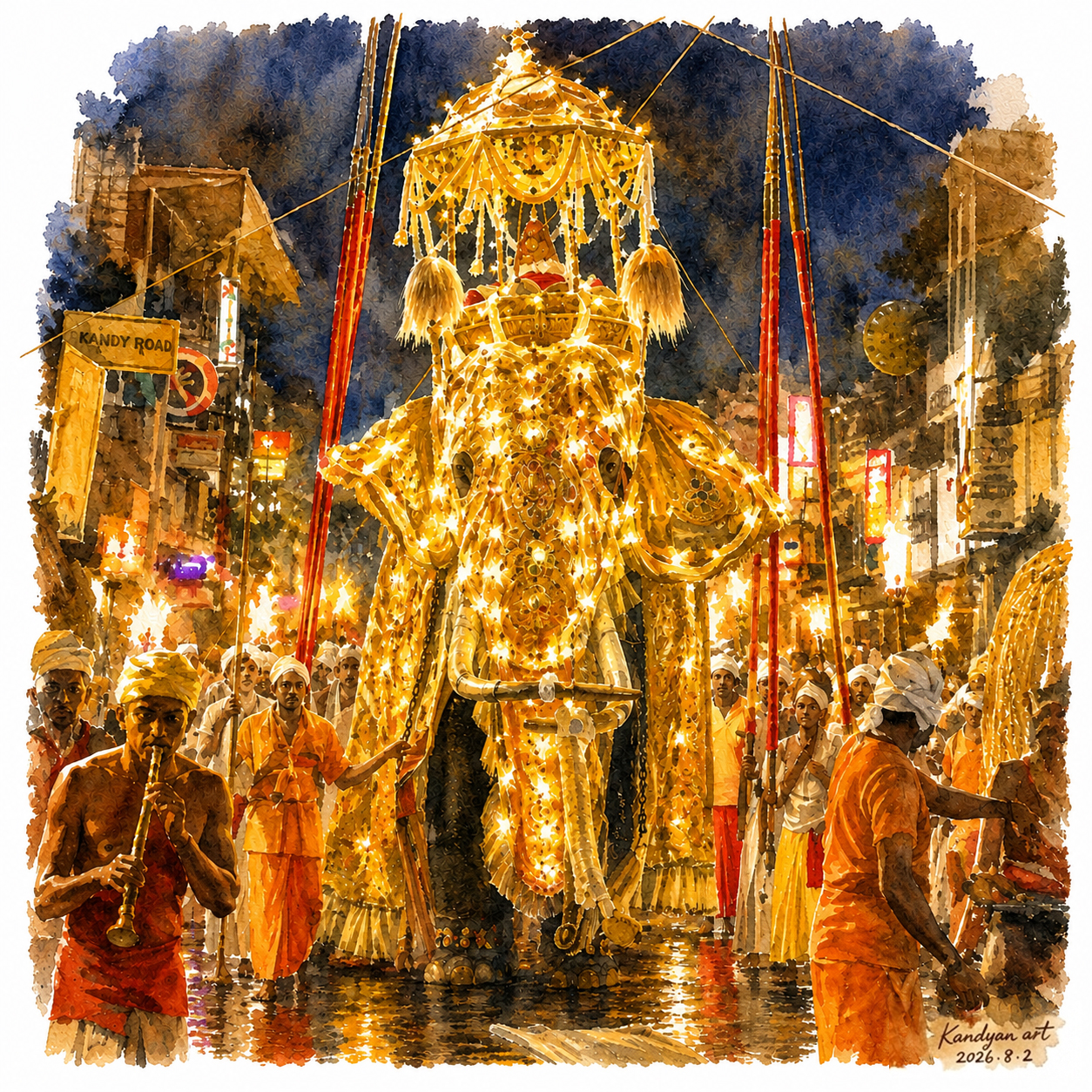
The use of elephants in Sri Lankan religious processions represents one of the strongest surviving examples of this cultural continuity. Decorated elephants participating in ceremonies are not simply displays of tradition; they represent the continuation of historical relationships between religion, royalty, craftsmanship and animal knowledge.
The annual procession of the Sri Dalada Maligawa in Kandy, commonly known as the Esala Perahera, is one of the most internationally recognized examples. The tradition involves decorated elephants participating in a major Buddhist cultural event connected with the Sacred Tooth Relic of the Buddha. The presence of elephants in such ceremonies reflects centuries of association between elephants and sacred authority.
Within these traditions, the mahout continues to hold an important role. The disciplined movement of ceremonial elephants requires deep understanding of animal behaviour and careful training. The ability to guide an elephant through large crowds, lights, sounds, and complex environments reflects generations of specialized knowledge.
The Ankusha belongs to this historical environment. Although many surviving examples are difficult to date precisely, elephant handling instruments found in Sri Lanka and preserved in museum collections demonstrate that such tools were part of the broader tradition of elephant management on the island.
Sri Lankan examples often reflect the artistic preferences of local craftsmen. While connected to wider South Asian forms, they frequently incorporate regional approaches to metalwork, decorative patterns and symbolic imagery. Brass, iron and other metals were used according to purpose, availability and the status of the owner.
The relationship between the Ankusha and Sri Lankan craftsmanship is especially significant because the island has a long history of metalworking traditions. Bronze casting, brass production and decorative metal arts developed alongside religious and royal institutions. Objects connected with important cultural practices were often transformed from simple functional items into works of artistic expression.
The decoration of elephant related objects often reflected broader Sri Lankan artistic traditions. Motifs inspired by animals, plants and mythical creatures connected practical objects with cultural meanings. Similar symbolic languages appear throughout temple architecture, sculpture, jewellery and ceremonial objects.
The Makara, lion, floral patterns, and other traditional forms frequently appear in South Asian decorative arts. When these motifs were applied to elephant related objects, they created a connection between the practical world of craftsmanship and the symbolic world of religion and kingship.
The importance of the Ankusha in Sri Lanka therefore exists on multiple levels. At the practical level, it was an instrument connected with elephant management. At the social level, it represented the profession and knowledge of the mahout. At the artistic level, it demonstrated the skill of metalworkers. At the cultural level, it preserved the memory of Sri Lanka’s historical relationship with elephants.
The decline of elephants as instruments of warfare and large scale labour during the modern period changed the practical role of the Ankusha. However, its cultural importance continued. Instead of remaining only a working tool, it became a heritage object representing a historical tradition.
Museums, collectors, and craftsmen preserve ankushas today because they provide evidence of a unique relationship between humans and animals. They demonstrate how ancient societies developed specialized knowledge to work with elephants and how practical objects could become carriers of cultural memory.
For Sri Lanka, the Ankusha represents more than a connection to elephants. It represents the meeting point of ancient kingdoms, Buddhist traditions, royal symbolism, traditional craftsmanship and generations of inherited knowledge.
A traditional brass Ankusha therefore stands as a material witness to a chapter of Sri Lankan history in which elephants were not only animals of strength but also symbols of civilization itself.
The Ankusha as a Heritage Object: Metallurgy, Artistic Evolution, Museum Evidence and Its Meaning in the Modern World
The Ankusha has travelled through history in a unique way. It began as a practical instrument developed from the necessity of communicating with one of the largest and strongest land animals on Earth. Over centuries, however, it became much more than a working tool. Through the hands of mahouts, blacksmiths, royal craftsmen, religious communities, and collectors, the Ankusha transformed into a cultural object that preserves knowledge about technology, artistry, social organization, and the relationship between humans and elephants.
Unlike many historical objects whose purpose disappeared completely with technological change, the Ankusha continues to carry meaning because it represents a living connection between past and present. Even when no longer required as an everyday elephant handling tool, it remains a symbol of traditional knowledge systems that developed over thousands of years.
- The Metallurgical Tradition Behind the Ankusha
The creation of a traditional Ankusha required knowledge of metallurgy, forging, casting and finishing techniques. Although the exact manufacturing methods varied between regions and historical periods, the basic objective remained consistent: producing an instrument strong enough for practical use while maintaining a form suitable for precise handling.
Early working ankushas were generally produced from iron or steel because these materials provided the necessary strength and durability. Ironworking traditions existed across South Asia from ancient times, and skilled metalworkers developed techniques for producing tools capable of surviving demanding conditions. The quality of the metal was particularly important because an Ankusha needed to withstand repeated mechanical stress during use.
As the instrument became associated with royal courts and ceremonial traditions, materials and manufacturing methods became increasingly diverse. Brass, bronze, copper alloys, silver, gold, and decorative materials were incorporated into different examples. These changes did not always reflect improvements in practical performance; rather, they often represented changes in social meaning, status and artistic value.
Brass became especially important in decorative and ceremonial ankushas because it combined practical and aesthetic advantages. It could be cast into complex forms, engraved with detailed patterns, polished to produce a golden appearance, and preserved for generations with relatively simple maintenance. These qualities made brass suitable for objects intended to represent permanence and heritage.
Traditional craftsmen understood material behaviour through experience. They knew how metals responded to heat, pressure, shaping and finishing processes. Much of this knowledge was transmitted through apprenticeship rather than written technical manuals. A master artisan’s understanding of metal was developed through years of observation and practice, similar to the way mahouts developed knowledge of elephant behaviour through direct experience.
- The Transformation from Tool to Art Object
The evolution of the Ankusha from a functional tool into an artistic object reflects a broader pattern found throughout South Asian craftsmanship. Objects connected with royal authority, religious practice, and ceremonial life often received artistic treatment beyond their original purpose.
A working Ankusha needed to be reliable, balanced and durable. A ceremonial Ankusha, however, carried additional responsibilities. It had to communicate prestige, authority and cultural identity. As a result, craftsmen began incorporating elaborate decorative elements into the instrument’s design.
Handles became areas of artistic expression. Craftsmen created detailed forms using engraving, casting, inlay and sculptural techniques. Animal motifs, floral patterns, mythical creatures, and geometric designs transformed ordinary tools into objects worthy of royal collections and ceremonial display.
This artistic transformation did not remove the original meaning of the Ankusha. Instead, it added additional layers of interpretation. The object continued to represent elephant management while simultaneously becoming a symbol of power, craftsmanship and cultural memory.
- Symbolism in Ankusha Design
The decorative language of traditional ankushas reflects the wider symbolic traditions of South Asian art. Craftsmen often selected motifs that represented strength, protection, prosperity and spiritual ideas.
The lotus, for example, appears frequently in South Asian artistic traditions and is associated with purity, spiritual development and sacred symbolism. Floral patterns represented growth, harmony and the beauty of nature.
Animal motifs carried their own meanings. Lions represented authority and courage, elephants represented strength and wisdom, and mythical creatures such as the Makara represented protection and cosmic forces.
The inclusion of such designs demonstrates that artisans did not view the Ankusha merely as a mechanical object. The decoration transformed the instrument into a visual expression of the cultural world surrounding elephants.
- The Ankusha in Religious and Philosophical Traditions
Although the Ankusha originated as an elephant management instrument, its symbolism expanded into religious and philosophical traditions throughout South Asia.
Within Hindu traditions, the Ankusha became one of the attributes associated with Ganesha, the elephant headed deity widely revered as the remover of obstacles. In this symbolic context, the hook represents guidance, discipline, and the ability to direct the mind away from confusion and toward wisdom.
The meaning of the Ankusha in this context is not physical control but spiritual direction. The same principle that guided an elephant through understanding became a metaphor for guiding human consciousness.
Buddhist traditions also incorporated the imagery of the Ankusha as a symbolic representation of mental discipline. The restless nature of the human mind was sometimes compared to a powerful animal requiring wisdom and awareness to guide it.
Through these interpretations, the Ankusha moved beyond its original practical role and became part of a broader philosophical language shared across South Asian cultures.
- Museum Evidence and Historical Preservation
The survival of historical ankushas today is largely due to museums, archaeological collections, royal repositories and private heritage collections. These preserved examples allow researchers to study changes in design, materials, craftsmanship and cultural meaning.
Institutions such as the British Museum preserve South Asian elephant related objects, including examples associated with elephant management traditions. Such collections provide important evidence regarding the existence and diversity of historical ankushas.
Other museums and cultural institutions across India and Sri Lanka also preserve elephant related objects, metalwork and royal artifacts. These collections demonstrate that the Ankusha was not a single standardized design but a category of objects that evolved according to regional traditions, artistic preferences and historical circumstances.
Museum research is especially valuable because many traditional practices were transmitted orally. Physical objects therefore become essential sources of evidence for understanding past technologies and cultural systems.
- The Sri Lankan Ankusha and Local Craft Identity
Within Sri Lanka, the Ankusha represents the connection between elephant traditions and the island’s long established metalworking heritage.
Sri Lankan craftsmen developed distinctive approaches to decorative metalwork, often incorporating local artistic influences into objects connected with religious and royal traditions. The island’s history of brass craftsmanship, particularly in regions known for traditional metal industries, contributed to the continued production of heritage objects inspired by historical forms.
A Sri Lankan brass Ankusha therefore represents two interconnected traditions: the ancient knowledge of elephant management and the craftsmanship of metalworkers who preserved artistic techniques across generations.
The importance of such objects lies not only in their appearance but also in the cultural knowledge they carry. The form of the Ankusha connects modern artisans with historical craftsmen, while its symbolism connects present communities with centuries of elephant related traditions.
- The Ankusha in the Modern World
The practical role of the Ankusha has changed significantly in the modern era. The decline of elephants in warfare, transportation, and heavy labour reduced the need for many traditional elephant management tools. However, the cultural importance of the Ankusha continued.
Today, the Ankusha exists in several forms. Some examples remain connected with traditional elephant practices, while others are preserved as museum artifacts, religious symbols, decorative heritage objects or works of contemporary craftsmanship.
Its survival demonstrates that cultural objects often outlive their original functions. A tool can become a historical document, preserving information about technology, social structures and human relationships with the natural world.
However, modern understanding of the Ankusha also requires historical awareness. The object should be studied within the full context of elephant management traditions, including the knowledge and responsibilities of mahouts. The true significance of the Ankusha does not come from the instrument alone but from the entire relationship between human beings and elephants that gave it meaning.
- The Continuing Legacy of the Ankusha
The Ankusha remains one of the most fascinating examples of how a practical object can become a symbol of civilization. Its small physical form contains evidence of enormous historical systems: royal administration, military organization, animal knowledge, metallurgy, craftsmanship and religious philosophy.
For historians, it provides insight into ancient societies that developed sophisticated methods of working with elephants. For archaeologists, it represents a valuable material record of technological development. For artisans, it continues to inspire traditional craftsmanship. For cultural communities, it represents a connection with inherited heritage.
The enduring importance of the Ankusha lies in the relationship it represents. It reflects a period of human history when success depended not on overpowering nature but on understanding it. The instrument itself was never the source of true authority; knowledge, patience and cooperation created the bond between human and elephant.
A traditional Brass Ankusha therefore stands as more than a handcrafted object. It is a physical reminder of thousands of years of accumulated wisdom, preserved through the combined efforts of mahouts, craftsmen, rulers, scholars and communities who recognized the extraordinary significance of the elephant in human civilization.
Reviews
There are no reviews yet.